Pressure Vacuum Breakers: How They Work
A pressure vacuum breaker stops irrigation water from siphoning back into your drinking supply. Here is how a PVB works, where it belongs, and when to test it in Yorba Linda.
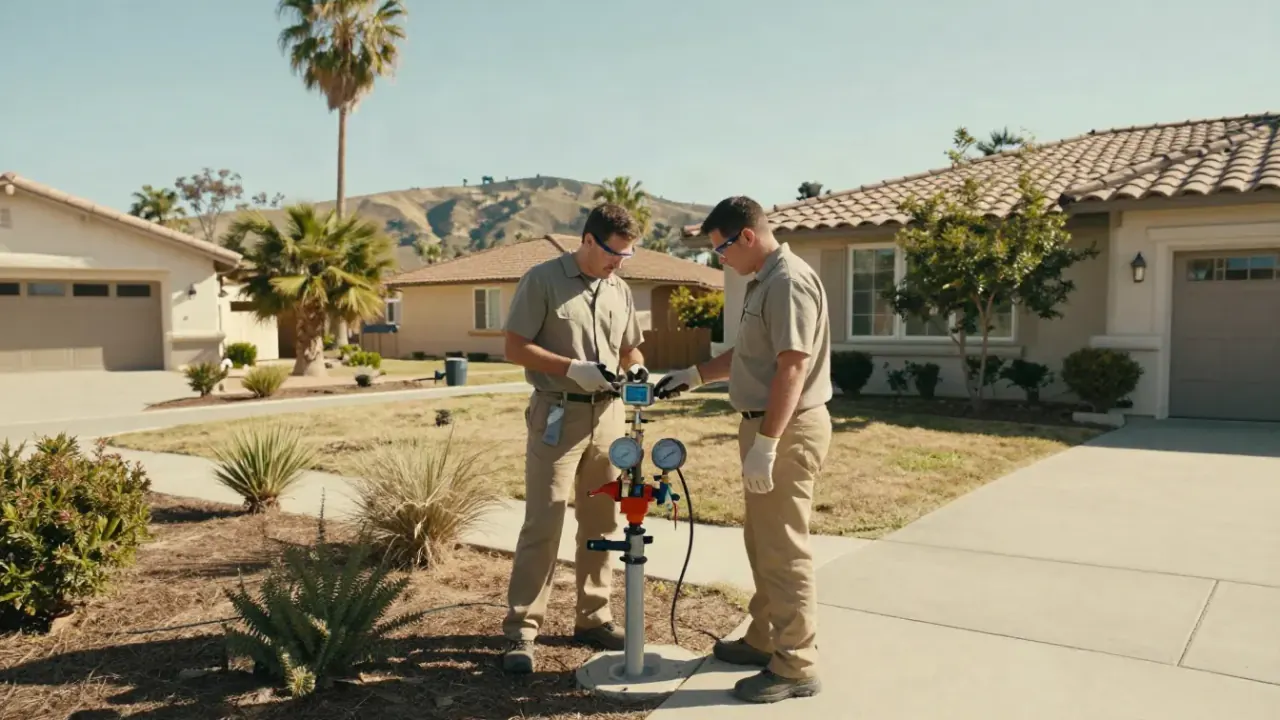
A pressure vacuum breaker stops irrigation water from being pulled backward into your drinking water supply when system pressure drops. It does that with a spring-loaded check valve that seals under normal flow and a vent that opens to atmosphere the moment downstream pressure falls below the supply pressure. If you have a sprinkler system in Yorba Linda, you almost certainly have one of these assemblies in your yard. This post explains the mechanics, where the device belongs, how local testing rules work, and what we see go wrong on PVBs across Yorba Linda and Orange County.
What a Pressure Vacuum Breaker Actually Does
A pressure vacuum breaker is a mechanical backflow prevention assembly that keeps irrigation water from siphoning back into the potable water line that feeds your house. It is a category of backflow preventer designed specifically for health-hazard cross-connections where the downstream water touches soil, fertilizer, or standing water.
The physics are simple. Your water district pushes water at roughly 60 to 80 psi into your service line. When that pressure holds, water flows forward through the PVB and out to your sprinklers. When pressure drops - a main break, a fire hydrant opened down the street, a sudden high-demand morning - the flow can reverse. Without a PVB, dirty irrigation water gets pulled back into the same pipe that fills your kitchen faucet.
The PVB blocks that reversal two ways. The check valve closes against reverse flow, and the air vent on top opens to break any vacuum that tries to pull water backward. Both parts have to work. If either fails, the assembly fails its test.
How Does a Pressure Vacuum Breaker Work Step by Step?
A pressure vacuum breaker works in four stages: forward flow, pressure loss, vent opening, and reseal. Each stage depends on the one before it, which is why a single worn O-ring can take the whole assembly out of compliance.
- Normal flow. Supply pressure pushes the check valve disc open. Water travels up through the body and out to the irrigation zone. The vent stays closed because the disc is holding it shut.
- Pressure drop. If supply pressure falls below the downstream pressure - even briefly - the check valve springs shut.
- Vent opens. With the check valve closed, the vent poppet lifts and exposes the chamber to open air. Any vacuum that would have pulled irrigation water backward is broken by atmosphere.
- Reseal. When supply pressure returns, the check valve reopens, the vent closes, and water flows forward again.
The whole cycle can happen in under a second. That is why we test PVBs with a differential pressure gauge rather than by eye. A PVB that looks fine can fail the check valve hold test at 1 psi and let contaminated water slip past.
We see this constantly on older assemblies in East Lake Village Backflow Testing where 1990s-era PVBs have never had a rebuild. The brass body is fine; the rubber is not.
Where Is a Pressure Vacuum Breaker Installed in Yorba Linda?
A pressure vacuum breaker is installed above ground, at least 12 inches above the highest sprinkler head or emission point it serves, on the discharge side of the irrigation shutoff valve. That height rule is not optional - the vent has to sit above every downstream outlet or the assembly cannot do its job.
In Yorba Linda you will find PVBs in three typical spots:
- Beside the irrigation shutoff and valve box, usually against the side yard fence or on a small riser near the meter.
- On a stub-up behind the front planter, often tucked behind a shrub where it is hard to read the test tag.
- On hillside lots where the sprinkler zones climb, mounted higher on the slope so the 12-inch clearance holds.
Yorba Linda sits at the base of the Chino Hills, and a lot of our neighborhoods are built on slopes. That matters for PVB placement. On a property in Vista del Verde Backflow Testing we routinely see the assembly mounted 18 to 24 inches up a retaining wall so the top-of-slope sprinklers stay below the vent. If your PVB is level with or below the highest head, it fails on installation, not on wear.
We handle placement questions on every Pressure Vacuum Breaker (PVB) Service Yorba Linda CA call. If the height is wrong, we tell you before we test.
PVB vs Other Backflow Devices in Yorba Linda
A PVB is not the same as a double check valve or a reduced pressure assembly, and using the wrong device on the wrong application is the fastest way to fail a water district inspection. Each assembly is rated for a specific hazard level and a specific installation orientation.
Here is how the three common assemblies compare for Yorba Linda properties:
- Pressure vacuum breaker (PVB). Irrigation only. Must be installed above the highest downstream outlet. Not rated for backpressure - if your system has a booster pump or a pressurized downstream loop, a PVB is the wrong choice.
- Double check valve assembly (DCVA). Used for low-hazard, non-health applications like fire sprinkler lines and some commercial domestic lines. Can be installed below grade in a vault.
- Reduced pressure zone assembly (RPZ). The highest protection level. Handles both backsiphonage and backpressure. Required on many commercial and fire line applications in Orange County.
If your irrigation system has a pump, a PVB cannot legally protect it. You need an RPZ. We see this mistake on larger lots in Kerrigan Ranch Backflow Testing where homeowners add a booster pump to push water up a long slope and never update the backflow device.
When a PVB is the right call, we install it correctly the first time. Our Backflow Preventer Installation Yorba Linda CA work includes the height check, the test, and the paperwork your water district wants on file.
Testing Rules and How Often a PVB Needs Certification
Yorba Linda irrigation PVBs must be tested annually by a certified backflow tester, and the results filed with your water provider. The city sits in a service area where Yorba Linda Water District and the surrounding agencies enforce annual certification on all testable assemblies.
Annual testing is not a suggestion. If your assembly is on the district's list and you skip a year, you can receive a compliance notice, and in some cases a shutoff notice on the irrigation meter. The test itself takes about 15 to 25 minutes per assembly and costs $75 to $125 in 2026 pricing for a standard PVB in this area.
What the test actually checks:
- Check valve hold. The tester uses a differential pressure gauge to confirm the check valve holds at or above 1.0 psi.
- Air inlet opening. The vent must open at 1.0 psi or greater.
- Leak check. No drips from the vent, bonnet, or test cocks under normal flow.
We file the results directly with the district through our Water District Compliance Reporting Yorba Linda CA process, so you do not have to chase paperwork. If the assembly fails, we quote the repair on the spot.
For a broader look at what annual certification covers on every assembly type, our Annual Backflow Assembly Testing Yorba Linda CA page walks through the full checklist.
Can a Pressure Vacuum Breaker Freeze in Yorba Linda?
A pressure vacuum breaker can freeze and crack in Yorba Linda, and it happens more often than people expect. Yorba Linda sits in a foothill microclimate where winter overnight lows drop into the low 30s several times between December and February, and the PVB is the most exposed backflow assembly on the property.
Three things make a PVB vulnerable:
- It sits above ground with no soil insulation.
- It holds a small amount of water in the body and test cocks after the irrigation valve closes.
- It is often on the shaded north or east side of the house, where frost lingers past sunrise.
Water expands about 9 percent when it freezes. That is enough to split a brass bonnet or push the vent poppet out of alignment. A cracked PVB body will not hold pressure and will fail its next certification.
What we do before a cold snap: shut the irrigation valve, open the test cocks, and drain the assembly. If you are going out of town in January, that 10-minute step saves a $250 to $450 replacement. If the body does crack, we handle the swap through our Backflow Preventer Replacement Yorba Linda CA service and retest the same week.
Common Mistakes We See on Yorba Linda PVB Assemblies
The same handful of mistakes show up on PVB calls across Yorba Linda, and most of them trace back to installation or winter neglect rather than normal wear. Here is what to watch for.
- Mounted too low. If the vent is not 12 inches above the highest sprinkler head, the assembly cannot protect the line. This is the number one install error we correct.
- Buried in a valve box. A PVB must be above ground and accessible. We find them inside irrigation boxes on older properties, which is both a code violation and a test failure.
- No clearance for testing. Test cocks buried in mud or blocked by a fence make certification impossible without digging out the assembly first.
- Left charged over winter. Water sitting in the body through a 32-degree night is how bodies crack.
- Wrong device for a pumped system. A booster pump downstream of a PVB is a backpressure hazard the PVB cannot handle.
- Skipped annual tests. Rubber degrades whether you test or not. A PVB that passed three years ago can fail today.
We see the buried-assembly problem most often in the older tracts around Placentia Backflow Testing and the Yorba Linda neighborhoods that border it, where original 1970s and 1980s irrigation was installed before the current height rules were enforced.
When to Call a Professional
Call a certified tester when your annual certification is due, when you see water pooling around the assembly, or when the vent is dripping during normal irrigation. Those three symptoms cover about 90 percent of the PVB problems we solve.
You should also call if you are adding a pump, changing the irrigation layout, or moving a fence or hardscape near the assembly. Any of those can change the height clearance and turn a passing PVB into a failing one.
Yorba Linda Backflow Testing handles PVB testing, repair, and replacement across the city, and we file directly with your water district so you never have to wonder whether the paperwork went through. We test, we tag, we report. You get a compliant assembly and a clean record.
Frequently Asked Questions
How does a pressure vacuum breaker work in Yorba Linda CA?
A PVB uses a spring-loaded check valve to stop reverse flow and an air vent that opens when supply pressure drops. In Yorba Linda, it protects your irrigation line from siphoning soil and fertilizer back into the drinking water supply that feeds your house.
What is a PVB used for in Yorba Linda California?
A PVB is used on irrigation systems to prevent backflow contamination. It is required on sprinkler systems connected to the potable water supply, and it must be tested annually by a certified tester and reported to your water district.
Where is a pressure vacuum breaker installed in Yorba Linda?
Above ground, on the discharge side of the irrigation shutoff valve, at least 12 inches above the highest sprinkler head. On Yorba Linda hillside lots, that usually means mounting it on a riser or retaining wall so the top zone stays below the vent.
How often does a PVB need testing in Yorba Linda CA?
Every 12 months. Yorba Linda Water District and surrounding agencies require annual certification on testable backflow assemblies. The test takes 15 to 25 minutes and costs $75 to $125 in 2026 for a standard PVB.
Can a pressure vacuum breaker freeze in Yorba Linda?
Yes. Winter overnight lows in the low 30s can crack a charged PVB body. Shut the irrigation valve, open the test cocks, and drain the assembly before a cold snap. A cracked body means replacement, typically $250 to $450.
Get Help With Backflow Testing in Yorba Linda
If your PVB is due for certification, dripping at the vent, or sitting lower than it should, we can test it, repair it, and file the report with your water district in one visit. We serve every Yorba Linda neighborhood and the surrounding Orange County cities.
Call Yorba Linda Backflow Testing at (714) 880-7120 to schedule your annual PVB test or a same-week repair.